Lake Weed Removal & Aquatic Weed Cutting — Lake Travis, Lake Austin & Highland Lakes
The short answer
We mechanically remove hydrilla, milfoil, cattails, and water hyacinth from Highland Lakes shorelines with a Truxor amphibious harvester — no herbicide, no waiting for plants to die in place. Spot dock-access clearings and whole-shoreline programs across Lake Travis, Lake Austin, Lake LBJ, Lake Marble Falls, Canyon Lake, Lake Buchanan, and Inks Lake.
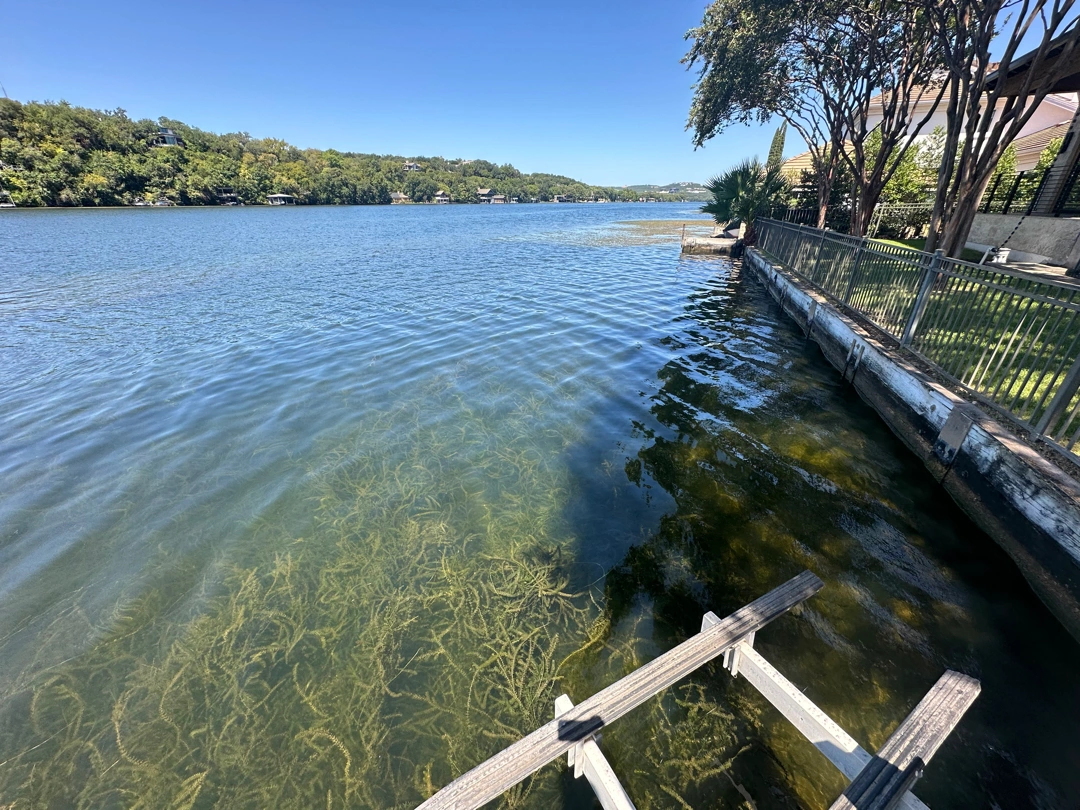
Aquatic weeds are the single most common complaint we hear from Highland Lakes homeowners between June and October. The cove that was crystal in April is suddenly a mat of hydrilla in July. The swim platform is fouled. The boat lift bunks are tangled. The neighbor's dog won't go in the water. And the standard fix offered by most Central Texas lake-service companies — broadcast herbicide and wait — leaves the dead vegetation rotting in place for weeks, depleting oxygen, fueling algae blooms, and producing the muck homeowners then call about a year later.
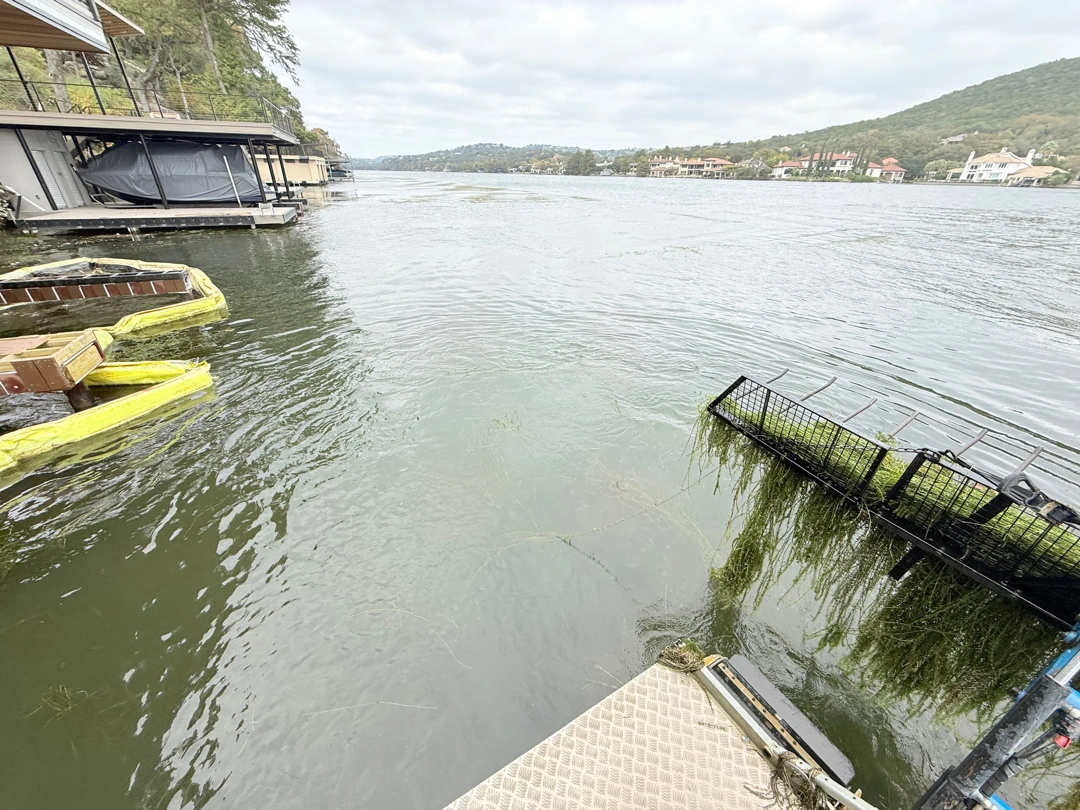
ATX Lakescapes does this work differently. We run a Truxor amphibious harvester — a specialized machine built for exactly this work. It operates in water too shallow for a boat and on land too wet for equipment. Most weed removal companies in Central Texas are pulling weeds by hand or spraying herbicide. We're removing them mechanically, at scale, without chemicals near your waterfront.
We've cleared dock access for hundreds of properties on Lake Travis and Lake Austin and run whole-shoreline programs on the upstream Highland Lakes where invasive growth pressure is highest. The work is faster than homeowners expect, lighter on the lake than they expect, and almost always cheaper than the cycle of herbicide-and-muck-cleanup it replaces. Twelve years on this water has taught us what grows where, when it peaks, and how to keep your cove ahead of it instead of chasing it.
Lake Weed Removal Services
We size every job around what the property actually needs, not a flat package. Three service shapes cover almost every Highland Lakes homeowner who calls us.
Dock access clearing is the most common request. A homeowner wants the slip, the swim ladder, the lift bunks, and the immediate boat lane clear. Typical scope is 30–60 feet of waterfront and out to roughly 60 feet from shore, deep enough to launch and load comfortably. One Truxor visit usually handles it, and the cuttings come out the same day.
Whole-shoreline programs apply to properties with longer waterfronts, party-deck docks, multi-slip configurations, or HOA-managed coves where every owner is dealing with the same hydrilla mat. We map the cove, identify the species mix, and cut on a schedule that keeps the entire frontage open all season. This is the only way to stay ahead of hydrilla once it has established — spot clearings get reinfested from the neighbor's water within weeks.
Emergent and bankline clearing handles cattails, water primrose, alligator weed, and water hyacinth at the waterline and on the wet shoulder of the shoreline. The Truxor's tracked hull crawls onto banks no boat can reach, the cutter shears the stalks below the waterline, and the collector loads them out without disturbing the soil structure that holds your shoreline together.
Truxor Amphibious Harvester — What It Is and Why It Matters
The Truxor is a Swedish-built amphibious work platform purpose-engineered for shoreline and shallow-water vegetation work. The hull floats, the rubber tracks drive a small propeller in deep water and the tracks themselves on land, and the boom carries interchangeable attachments — cutter, collector, dredge head, weed rake. The unit weighs less than most pickup trucks, exerts a fraction of the ground pressure of a skid-steer, and works in 4 inches of water as comfortably as in 8 feet.
The practical effect on a Highland Lakes shoreline is this: the Truxor reaches places nothing else can. The marshy edge between a private dock and the seawall where hydrilla mats accumulate. The mouth of a cove where the depth drops too fast for a wading crew but is too shallow for a flat-bottom barge. The cattail bank that has been growing in the same spot for fifteen years because every previous contractor said it was unreachable.
Because the cutter shears at the root crown and the collector hauls the material to shore, the Truxor removes the biomass instead of leaving it to decay in the water column. That single distinction — biomass out, not killed in place — is the difference between a cove that clears in days and a cove that turns green and stinks for a month.
Common Aquatic Weeds in Highland Lakes
Four species drive almost every weed-removal call in the Highland Lakes. Knowing what you're looking at matters because each one behaves differently and responds to different cutting strategies.
Hydrilla
Hydrilla is the dominant invasive submerged aquatic plant in Lake Travis and Lake Austin, and it is the reason most homeowners call. It grows from tubers in the lakebed, can add more than a foot of stem per week in summer, and forms surface canopies that block boats and swimmers. Mechanical cutting at depth, repeated through peak season, keeps it from canopying. Fragmenting it by chopping with a boat prop makes it worse — every fragment can root.
Milfoil
Eurasian and variable-leaf milfoil show up most aggressively on Lake LBJ, Lake Marble Falls, and Inks Lake. Milfoil grows in deeper water than hydrilla, forms denser stems, and tangles into boat lift cables and prop shafts. We cut milfoil from the root crown and collect the cuttings the same pass — fragments that drift downstream root quickly in calmer water.
Cattails
Cattails are an emergent shoreline plant — stalks that grow from the wet bankline up out of the water. On Highland Lakes properties they accumulate at outflow points, in stagnant coves, and along seawall transitions. The Truxor cuts cattails at the waterline and loads the stalks out; left in place, mowed cattails regrow within a season because the rhizome mat remains intact below the waterline.
Water Hyacinth and Floating Mats
Water hyacinth is a floating invasive that explodes in warm, slow water — most often in upstream backwaters on Lake LBJ and the inflow arms of Lake Travis. It is on the Texas noxious-plant list. Mechanical removal is the only TPWD-preferred control method that does not introduce herbicide into the water column. We collect floating mats with the Truxor's surface attachment and dispose of them onshore in a permitted manner.
Dock Access Clearing
This is the work we do most: get the slip clear, get the lift clear, get the swim ladder clear, and put the homeowner back in the water for the weekend. A typical dock-access clearing on Lake Travis covers the dock footprint plus a 60-foot egress lane to deep water. The Truxor cuts a working perimeter around the dock, the operator works the lift bunks and ladder area by hand from the unit, and the collected vegetation is barged or driven to a shore dump point we coordinate with the homeowner in advance.
Most dock clearings are a one-day job. Homeowners on a maintenance schedule see us back every four to six weeks during peak growth, which keeps the property visit-ready without ever letting the cove fully canopy. We coordinate visits with our dock maintenance program so a single crew handles both the structure and the water around it.
Whole-Shoreline Programs vs Spot Treatment
Spot treatment works when the surrounding water is clean. On a fast-flushing cove on Lake Austin with low neighbor pressure, clearing a 50-foot waterfront once can hold the property for the season. On Lake Travis hydrilla coves, on stagnant Lake LBJ backwaters, and on any cove where two or three neighbors are letting the canopy run, spot clearings fail because the cleared zone is reinfested by drift within weeks.
Whole-shoreline programs solve this. We work with HOAs, lakeshore associations, and clusters of adjacent neighbors to clear contiguous frontage on a single mobilization, then maintain the entire stretch through the season. The per-foot cost drops, the result lasts, and the cove stays usable for everyone instead of three properties pretending the problem is the other neighbor's.
LCRA & TPWD Compliance
We are the LCRA permit applicant of record on every dock we build, and we apply the same compliance discipline to vegetation work. For routine maintenance clearing of submerged growth in front of an existing permitted dock, LCRA generally treats the work as dock maintenance and does not require a separate permit. For shoreline-emergent work that touches cattail mats at the waterline, work in protected coves identified by LCRA's habitat mapping, or any work involving listed invasives like water hyacinth, we coordinate with LCRA and TPWD before mobilizing.
We do not apply aquatic herbicides. That sidesteps the entire TPWD aquatic herbicide application certification regime and keeps every job inside the no-chemical compliance envelope homeowners actually want. Disposal of harvested vegetation is handled at upland dump sites coordinated with the property owner or HOA — never back into the water column.
Service Area
We run weed-removal mobilizations across the full Highland Lakes chain and Canyon Lake. Lake Travis and Lake Austin are our base operating waters. Lake LBJ, Lake Marble Falls, Lake Buchanan, and Inks Lake get scheduled in multi-property blocks so travel cost gets shared. Canyon Lake work is scheduled around weekend windows that minimize boat-traffic conflict. From our Leander, Travis County base we typically arrive on-site within a week of the first call, sooner during peak growth.
Frequently asked questions
Aquatic Defense Program
Stop hydrilla, milfoil & invasive weeds before they take your cove.
Hydrilla grows more than a foot per week in 80-degree water. Spot clearings get reinfested in three weeks. A scheduled season pass keeps your dock, slip, and swim zone open from first warm week to first cold front — mechanically, with the Truxor, no herbicide in the water column.
Single Clearing
One-time visit
from $1,200
- Dock access + lift bunk clearing
- 30–60 ft of waterfront
- Hydrilla, milfoil, primrose
- Cuttings hauled to shore
- Same-week scheduling May–Aug
Season Pass
Most popularMonthly visits May–Sept
from $3,950 / season
- 5 scheduled mechanical cuts
- Hydrilla & milfoil prevention
- Cattail & hyacinth bankline work
- Priority emergency dispatch
- LCRA/TPWD compliance handled
Whole-Shoreline
HOA & multi-property
Custom
- Cove mapping + species ID
- Coordinated neighbor frontage
- Per-foot pricing drops with scale
- Quarterly maintenance schedule
- Includes dock-tie-in care if needed
Pricing reflects typical single-dock, single-lift Highland Lakes properties. Final pricing confirmed after a free on-site visit.
Open enrollment formReady to talk through your project?
Free on-site visit across Lake Travis, Lake Austin, Lake LBJ, Lake Marble Falls, Lake Buchanan, Inks Lake, and Canyon Lake. Twelve years on this water, LCRA permit applicant of record on every build.